
How We Built Europe's First Business School FabLab Inside ESADE.
⚠ Article disponible en English.
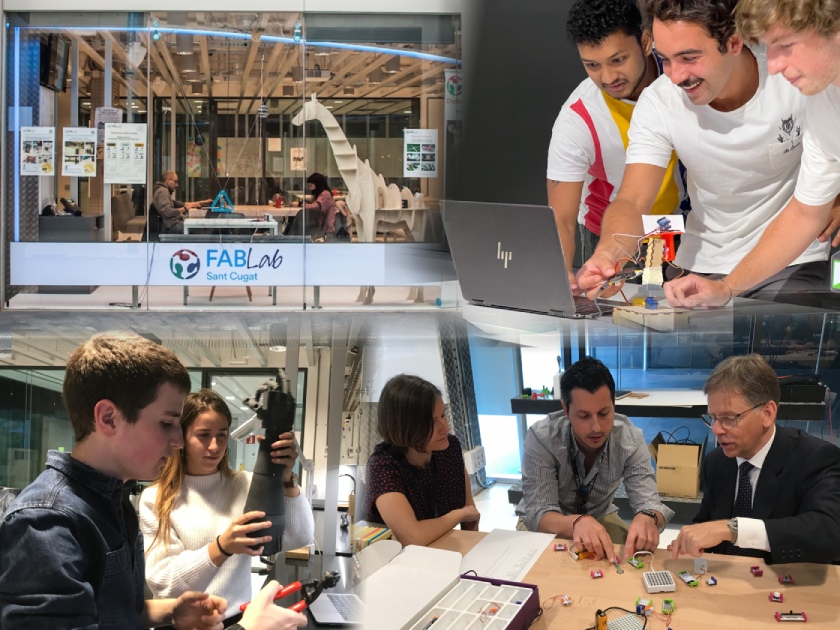
When ESADE Business School (one of Europe's top three business schools according to the Financial Times) decided it wanted an innovation lab, nobody was quite sure what that meant inside a business school.
A wet lab? A co-working space with beanbags? A room with Post-its on the wall?
We knew exactly what it should be: a FabLab. And in 2017, we built one.
What followed became the first FabLab inside a business school in Europe.
The Brief
ESADE wanted to make innovation tangible for its students. Not as a concept taught in lecture halls, but as a lived experience - something that students would make, not just study.
The challenge was real: business schools are built around case studies, frameworks, and presentations. Bringing in digital fabrication equipment and hands-on prototyping methodology meant rethinking how space, curriculum, and learning outcomes connect.
We were brought in to design and set up the entire operation: the physical space, the equipment, the curriculum, and the workshops.
What We Built
The Space
The ESADE FabLab is located at the Sant Cugat campus, now part of ESADE's Rambla of Innovation ecosystem. The space was designed from the ground up as a working fabrication lab — not a showroom, not a display case.
Equipment includes 3D printers for rapid prototyping, laser cutters for precision fabrication, electronics workbenches with Arduino, LittleBits, and Raspberry Pi, and tools for physical model-making and iteration.
The design principle was simple: every tool in the lab should produce something real within a single session. If a student walks in with an idea, they should be able to walk out with a prototype.
The Curriculum
We did not just install equipment and leave. We designed the innovation curriculum that makes the lab meaningful from day one.
Programmes we built workshops and tracks for:
- BBA (Bachelor in Business Administration) — introductory design thinking and prototyping workshops
- MBA — rapid prototyping intensives tied to real business briefs
- BiTLaSI (Bachelor in Technology, Law and Social Impact) — deeper maker skills integrated into the programme
- Executive programmes — innovation workshops for professionals returning to education
The methodology combines design thinking with physical prototyping: students move through empathy, definition, ideation, prototyping, and validation using real tools — not slides.
In the Classroom: What It Actually Looks Like
One team was given a brief to tackle single-use waste on campus. They ran weeks of interviews with coffee drinkers, mapped habits and friction points, built a reusable cup ecosystem with NFC technology and a gamified rewards app, validated it with real users, and pitched the working prototype directly to ESADE's CSR Director for campus deployment.
Nobody asked them to take it that far.
They had something real in their hands — and decided to see how far it could go.
That is what changes when students work in a FabLab. The threshold between "doing an assignment" and "solving a real problem" dissolves.
Corporate Partners in the Lab
The FabLab quickly became more than a teaching space. Companies including Fluidra, Audi, Roche Diagnostics, and RACC brought their employees to the lab for corporate innovation workshops.
In several cases, corporate teams worked directly alongside ESADE students — different levels of experience, different frames of reference, same problem to solve. The result was consistently the same: when the tools are real and the brief is live, rank becomes irrelevant. The best ideas won.
Results
- 1,000+ students across BBA, MBA, BiTLaSI, and Executive programmes
- 4 major corporate partners — Fluidra, Audi, Roche Diagnostics, and RACC — ran live innovation challenges in the lab
- 500+ high-school students visited the space through outreach initiatives
- Student teams won prizes at Maker Faire Barcelona
- The lab contributed to the founding of ESADE's Innovation Club
- The space is now integrated into ESADE's Rambla of Innovation ecosystem
What the First Visitor Taught Us
The first visitor to the ESADE FabLab after it opened was not a faculty member, not an MBA student, and not a corporate partner.
He was 15 years old. He arrived with a drone he had built himself. He asked if he could fly it inside.
It flew.
A few weeks later, he was teaching an MBA class what he knew about electronics and flight mechanics.
That moment said more about what a FabLab does than any metric. It collapses the usual hierarchy of expertise. The person who knows the most about the problem at hand teaches — regardless of their age, their title, or which programme they are enrolled in.
What This Means for Your School
Building a FabLab for ESADE taught us what works, what to avoid, and how to make the space genuinely useful from the first week — not after a year of trial and error. PlayLab offers three things:
- FabLab Setup — Equipment selection, space design, launch logistics, and staff training. We handle the full process from concept to opening day, calibrated to your budget and your campus.
- Curriculum Design — Design thinking and rapid prototyping tracks built into your existing BBA, MBA, and Executive programmes. Not as optional add-ons. As core experiences that students talk about years later.
- Workshops & Lectures — Hands-on sessions for students, faculty, and corporate partners. The kind that end with something built on the table, not a slide deck on a screen.
If you are a dean, programme director, or head of innovation exploring what this could look like at your institution, we would be glad to talk.
Frequently Asked Questions
How long does it take to set up a FabLab in a business school?
From initial brief to launch day, a typical FabLab setup takes between three and six months depending on scope and curriculum complexity. A smaller starter lab can be operational in under three months.
What equipment does a business school FabLab need?
The core kit — 3D printers, a laser cutter, and an electronics bench — is enough to run meaningful design thinking and prototyping workshops. We design the equipment list around your goals and budget, not the other way around.
Do students need a technical background to use a FabLab?
No. The ESADE FabLab was designed for business students with no engineering or fabrication background. Our workshops are structured so that students build their first prototype in session one, regardless of prior experience.
Can a business school FabLab attract corporate partners?
Yes — and it is one of the strongest arguments for building one. Fluidra, Audi, Roche Diagnostics, and RACC all chose to run innovation workshops at the ESADE FabLab. A physical lab gives companies a reason to come to your campus, not just sponsor a lecture.
What is the difference between a FabLab and a standard innovation hub?
A co-working space provides desks and wifi. A FabLab provides the tools to make physical things. Digital fabrication equipment means ideas become prototypes within hours, not weeks. That speed of materialisation changes student behaviour and learning outcomes.
How does a FabLab benefit MBA students specifically?
MBA students are trained to analyse problems and present recommendations. A FabLab adds a third capability: building something. Graduates who can move from strategic brief to physical prototype are significantly more useful to employers working on product innovation, service design, or digital transformation.